Assign cases
Let workers perform as many steps as possible for single cases
Reijers, H., & Liman Mansar, S. (2005). Best practices in business process redesign: an overview and qualitative evaluation of successful redesign heuristics. Omega, 33(4) All sources
category: Organization class: Allocation Rules frameworkAspect: Organizational Structure perspective: organizational/resource
Description
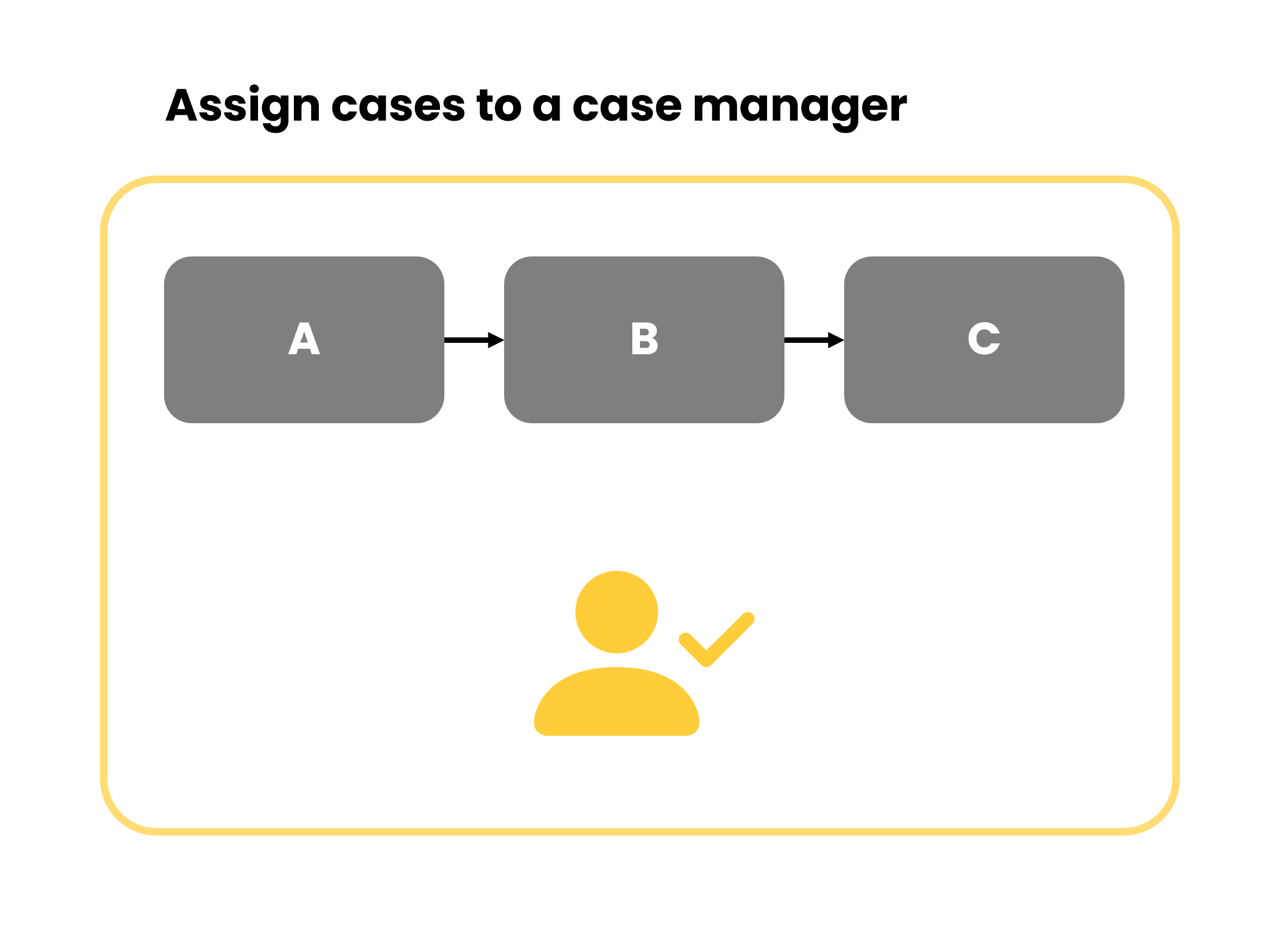
Assign cases states that the resource who has already worked on a case should, as far as possible, also perform its later steps. Instead of pushing each work item to whichever qualified resource becomes available next, the allocation rule prefers continuity: the same worker picks the case up again when it returns to the queue, for example after a customer reply or a missing document has arrived.
A case manager plays a crucial role in overseeing a case, but they are not necessarily involved in carrying out the entire workflow. In order to ensure efficient coordination, the process of assigning cases can be utilized. This involves selecting a resource who has previously worked on the case and is capable of performing the necessary tasks. Rather confusingly, this person is sometimes also referred to as case manager.
This pattern is different from the case manager pattern.
The pattern is the allocation counterpart to Combine activities. Both reduce how often someone has to familiarise themselves with a case: one by merging steps, the other by keeping the steps in one pair of hands. In its strictest form, the assigned worker is the only one allowed to touch the case. Softer forms only give that worker priority and release the case to colleagues when it would otherwise wait too long.
The case assignment heuristic is described by Rupp and Russell (1994), Reijers and Goverde (1998), and Van der Aalst and Van Hee (2002).
Key Takeaways
- Keep cases in one hand — Route follow-up steps to the worker who already knows the case to save set-up time.
- Prefer soft binding — Give the previous worker priority, but release the case to the pool before queue time becomes the bigger loss.
- Not a case manager — Case assignment concerns who executes the steps, whereas a case manager is accountable for the case without necessarily doing the work.
- Respect separation of duties — Approval or control steps that require a second person cannot be assigned to the same worker.
Performance considerations
■ This pattern ■ Baseline
The obvious advantage of the rule is that this person will get acquainted with the case and will need less set-up time. An additional benefit may be that the quality of service is increased. On the negative side, the flexibility of resource allocation is seriously reduced. A case may experience substantial queue time when its “case manager” is not available.
This matches the Devil’s Quadrangle profile. Time improves because repeated set-up and handover delays disappear, and quality improves because one person knows the case history and the customer deals with a consistent contact. Cost stays roughly neutral, since the same work is performed by the same type of resource. Flexibility worsens, because binding cases to individuals shrinks the effective resource pool per case. A soft rule, such as preferring the previous worker but releasing the case after a waiting threshold, limits this effect.
Example
Spotting the opportunity in event data
Framed along the FLAC rule types — fitness, location, attribute, constraint.
Case assignment is one of the patterns for which FLAC rulesets were built. Fitness: a low share of consecutive steps per case performed by the same resource; many distinct resources per case. Location: directly-follows activity pairs, or loops back to an earlier activity, performed by different resources of the same role. Attributes: distinct resources and handovers per case; longer processing time on a resource’s first touch of a case than on repeat touches; whether the first resource is qualified for the next step. Constraints: four-eyes or separation-of-duty rules; resources that are already bottlenecks; long absences that would make cases wait.
Sources & references
- Reijers, H., & Liman Mansar, S. (2005). Best practices in business process redesign: an overview and qualitative evaluation of successful redesign heuristics. Omega, 33(4) Summary on this site Publisher page DOI 10.1016/j.omega.2004.04.012
Enjoy these
Foundational free Patterns
Elevate physical constraints by applying new technology
Consider the division of a general activity into two or more alternative activities
Assign a responsible individual for handling each case type
Consider automating activities
Automate for environmental impact
Implement automation in a sustainable way
Buffer external information and subscribe to updates
Combine small activities into composite activities
Collect similar work items and work in batches
Constraint-based task assignment
Allocate tasks considering business process execution constraints
Connected to
Assign a responsible individual for handling each case type
Determine whether activities are related to the same type of case and, if necessary, distinguish new business processes
Establish a case-based mindset
Remove batch-processing and periodic activities from your business process
Form cross-department teams for end-to-end case handling.