Combine activities
Combine small activities into composite activities
category: Operation class: Task Rules frameworkAspect: Operation view perspective: functional
Description
Combine activities merges small consecutive activities into one composite activity performed by the same resource. Each separate activity carries a fixed overhead: the work item has to be picked up, the case file opened and understood, and the result handed over. When activities are very small, this overhead can exceed the actual processing time.
Task Combination is a process optimization technique that involves combining smaller tasks into larger ones. This technique reduces setup times, which are the time that resources need to become familiar with the specifics of a case, and can improve the quality of work. However, it is important to strike a balance between the size of the tasks and their workability. Tasks that are too large can result in smaller run-time flexibility and lower quality. Smaller tasks, on the other hand, can result in longer setup times.
The heuristic also covers the reverse move: dividing an activity that is too large to be workable into smaller ones. Combining activities often paves the way for other patterns. Merged steps frequently reveal intermediate checks or forms that are no longer needed (Eliminate activities), and they make it easier to keep a case with one worker (Assign cases). The pattern differs from Consolidate Work, which groups the same activity across many cases rather than different activities within one case.
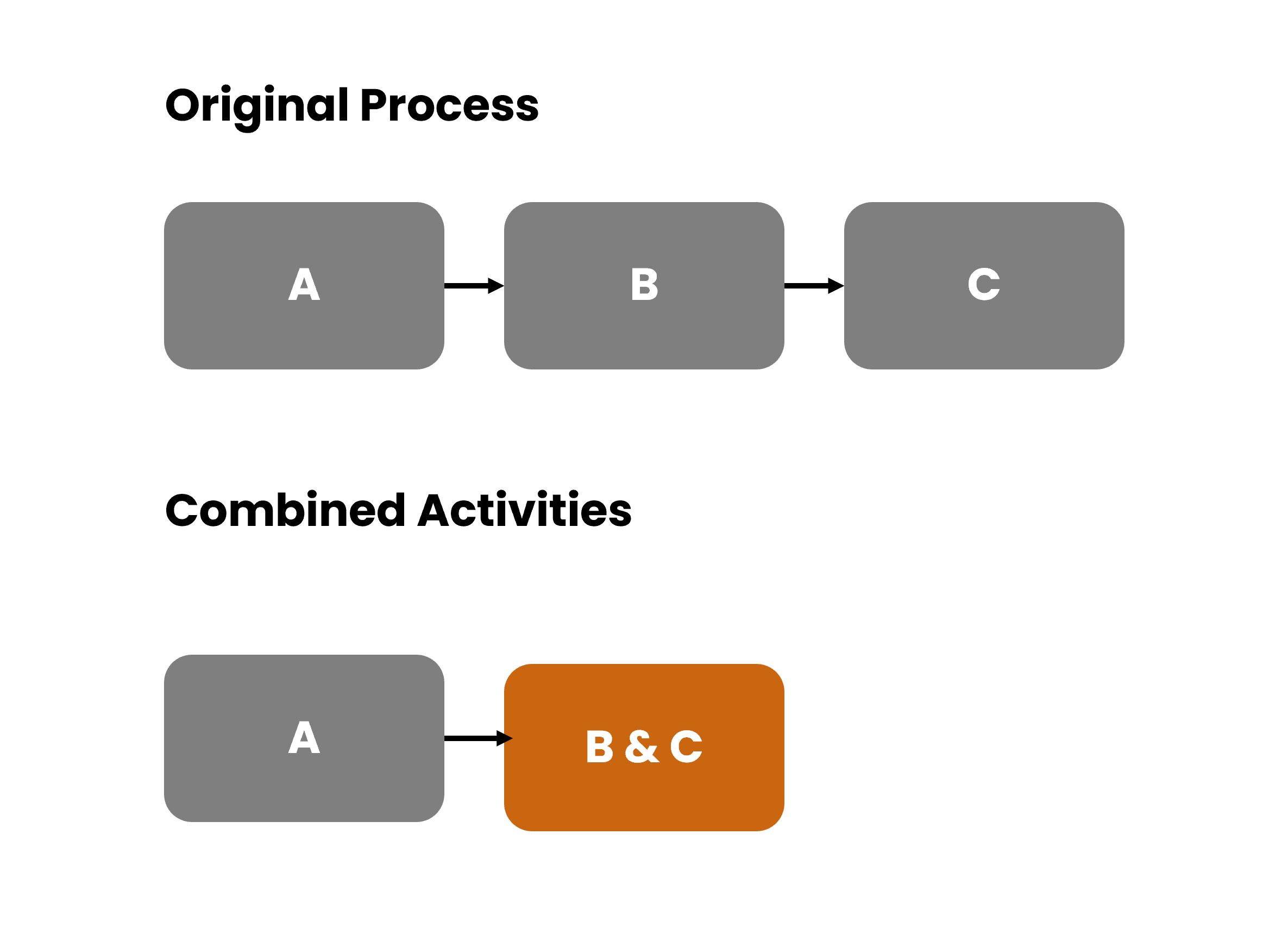 Task Combination
Key Takeaways
- Cut set-up and handovers — Merge small consecutive steps so that each case is opened, understood and handed over less often.
- Find the right size — Too small creates overhead, too large hurts quality and run-time flexibility.
- Check the skill profile — A combined activity must be executable by one role with the required skills and authority.
- Combine versus consolidate — Combining merges different steps within a case; consolidating groups the same step across cases.
Performance considerations
By finding the optimal balance, organizations can achieve the best of both worlds: shorter setup times, higher quality, and greater flexibility.
In Devil’s Quadrangle terms, combining activities mainly improves time and cost: set-up and handover delays between the merged steps disappear, and fewer handovers mean fewer chances to lose information, which supports quality. The price is usually paid in flexibility. Larger activities can only be performed by resources with all the required skills, which shrinks the resource pool, and they are harder to reschedule or distribute at run time. Activities that grow too large can also lower quality, because they become too complex for one person to perform well.
Example
Spotting the opportunity in event data
Framed along the FLAC rule types — fitness, location, attribute, constraint.
Fitness: processes with many short activities and many handovers per case. Location: directly-follows activity pairs with short processing times but long waiting times in between, especially when performed by different resources of a similar role. Attributes: ratio of waiting to processing time between the pair, handover frequency, repeated access to the same documents or fields, rework loops between the two activities. Constraints: the combined activity must fit one role in skill and authority; separation-of-duty rules; don’t merge if one part is a bottleneck that would then block the other.
Sources & references
- Being innovative without being creative
- Reijers, H., & Liman Mansar, S. (2005). Best practices in business process redesign: an overview and qualitative evaluation of successful redesign heuristics. Omega, 33(4) Summary on this site Publisher page DOI 10.1016/j.omega.2004.04.012
Enjoy these
Foundational free Patterns
Elevate physical constraints by applying new technology
Consider the division of a general activity into two or more alternative activities
Assign a responsible individual for handling each case type
Let workers perform as many steps as possible for single cases
Consider automating activities
Automate for environmental impact
Implement automation in a sustainable way
Buffer external information and subscribe to updates
Collect similar work items and work in batches
Constraint-based task assignment
Allocate tasks considering business process execution constraints
Connected to
Consider the division of a general activity into two or more alternative activities
Collect similar work items and work in batches