Consolidate Work
Collect similar work items and work in batches
Reijers, H., & Liman Mansar, S. (2005). Best practices in business process redesign: an overview and qualitative evaluation of successful redesign heuristics. Omega, 33(4) All sources
Description
Batch processing is an organized method of handling tasks by grouping similar activities together and executing them collectively, as opposed to dealing with each task individually. This systematic approach aims to enhance efficiency and streamline workflows by minimizing transitions between different types of tasks, allowing for a more structured and optimized workflow.
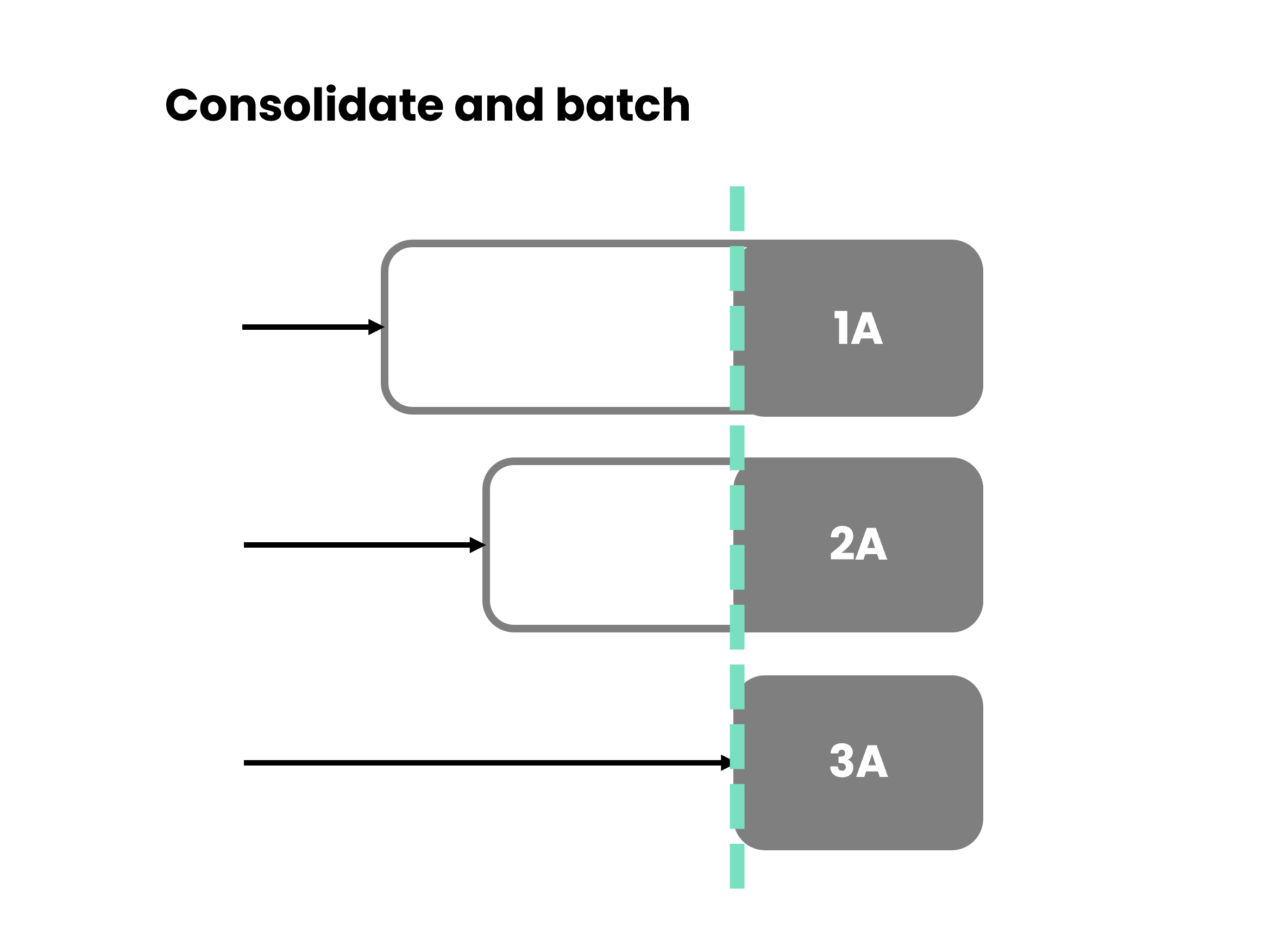
Consider batch processing as a way of categorizing and addressing tasks akin to organizing household chores. Much like cleaning all the rooms at once instead of moving back and forth, batch processing involves identifying tasks that share commonalities, such as similar steps or resource requirements. For instance, tasks like processing invoices or sorting data entries are prime candidates for grouping into batches, allowing for a more efficient and effective handling of these activities.
Batch processing is about figuring out which tasks can be done together because they’re kind of alike. For example, if you’re processing a bunch of invoices or sorting through data entries, these are tasks that share common steps. So, you group them into batches and handle them more efficiently.
While batch processing offers notable advantages, it is essential to maintain a focus on quality control and flexibility. Ensuring that each batch meets predefined standards is crucial, and the system should be adaptable to changes in task requirements. Regular monitoring of key performance indicators facilitates ongoing optimization. Striking the right balance between batch size and processing time is key to avoiding unnecessary complexity. In essence, batch processing serves as a strategic tool for enhancing efficiency, provided it is implemented with careful consideration of quality, flexibility, and balance.
Note that the pattern deliberately runs against Establish a case-based mindset: individual cases accept waiting for a batch in return for lower set-up effort and better utilisation. Which of the two fits depends on whether set-up effort or responsiveness dominates your objectives.
Key Takeaways
- Group by shared set-up — Batch activities whose preparation, tools or information are the same for many cases.
- Tune batch size and release — Release batches by size or time window so that waiting does not cancel out the efficiency gain.
- Provide an express route — Let urgent cases bypass the batch rhythm.
- The opposite of case-based work — Batching trades individual responsiveness for economies of scale; choose deliberately.
Performance considerations
■ This pattern ■ Baseline
The impact of batch processing on performance is analogous to getting more value from your efforts. By concentrating on one batch at a time rather than switching between various tasks, the approach not only accelerates task completion but also optimizes resource utilization. This results in cost savings and improved overall efficiency. Imagine handling paperwork more swiftly and being better equipped to adapt to changing workloads—this exemplifies the positive performance impacts of batch processing.
In the Devil’s Quadrangle, time and cost improve because set-up, switching and transport effort is incurred once per batch instead of once per case. The time gain refers to processing effort; for an individual case, waiting for the batch to fill adds delay, so batch size and release rules (by size or by time window) decide whether throughput time drops. Quality and flexibility are neutral overall.
Example
Spotting the opportunity in event data
Framed along the FLAC rule types — fitness, location, attribute, constraint.
Fitness: activities with high set-up effort relative to execution time that are currently executed one case at a time. Location: activities performed many times a day by the same resource on similar cases, interleaved with other work. Attributes: executions per resource and day, timestamp clustering (are executions already batched?), switching between activity types per resource, shorter processing times for later executions in a run. Constraints: tight due dates or service levels per case; cases that cannot wait; downstream steps that would be overloaded by work arriving in waves.
Sources & references
- Reijers, H., & Liman Mansar, S. (2005). Best practices in business process redesign: an overview and qualitative evaluation of successful redesign heuristics. Omega, 33(4) Summary on this site Publisher page DOI 10.1016/j.omega.2004.04.012
Enjoy these
Foundational free Patterns
Elevate physical constraints by applying new technology
Consider the division of a general activity into two or more alternative activities
Assign a responsible individual for handling each case type
Let workers perform as many steps as possible for single cases
Consider automating activities
Automate for environmental impact
Implement automation in a sustainable way
Buffer external information and subscribe to updates
Combine small activities into composite activities
Constraint-based task assignment
Allocate tasks considering business process execution constraints
Connected to
Buffer external information and subscribe to updates
Combine small activities into composite activities