Work in customer teams
Form cross-department teams for end-to-end case handling.
Reijers, H., & Liman Mansar, S. (2005). Best practices in business process redesign: an overview and qualitative evaluation of successful redesign heuristics. Omega, 33(4) All sources
category: Organization class: Allocation Rules frameworkAspect: Organizational Structure perspective: organizational/resource
Description
Customer teams are an advantageous method that brings together employees from various departments to handle specific types of process instances or cases. The primary responsibility of the team is to oversee a case, with individual members not necessarily involved in executing the case itself. This collaborative approach allows for easy access to shared and distributed knowledge, departmental resources, and tools, enabling a comprehensive examination of a case from multiple perspectives. By utilizing customer teams, organizations can enhance their problem-solving capabilities and provide more efficient and effective resolutions for their customers.
In contrast to Assign cases, where one worker performs as many steps as possible, a customer team pools the skills of several departments around a defined group of cases, for example a customer segment, a region or a product line. Members remain experts in their discipline but work together on the same cases, which shortens communication lines and turns coordination into a quick conversation rather than a formal handover between departments. Teams can be permanent, for stable case groups such as key accounts, or temporary, for complex cases such as large projects.
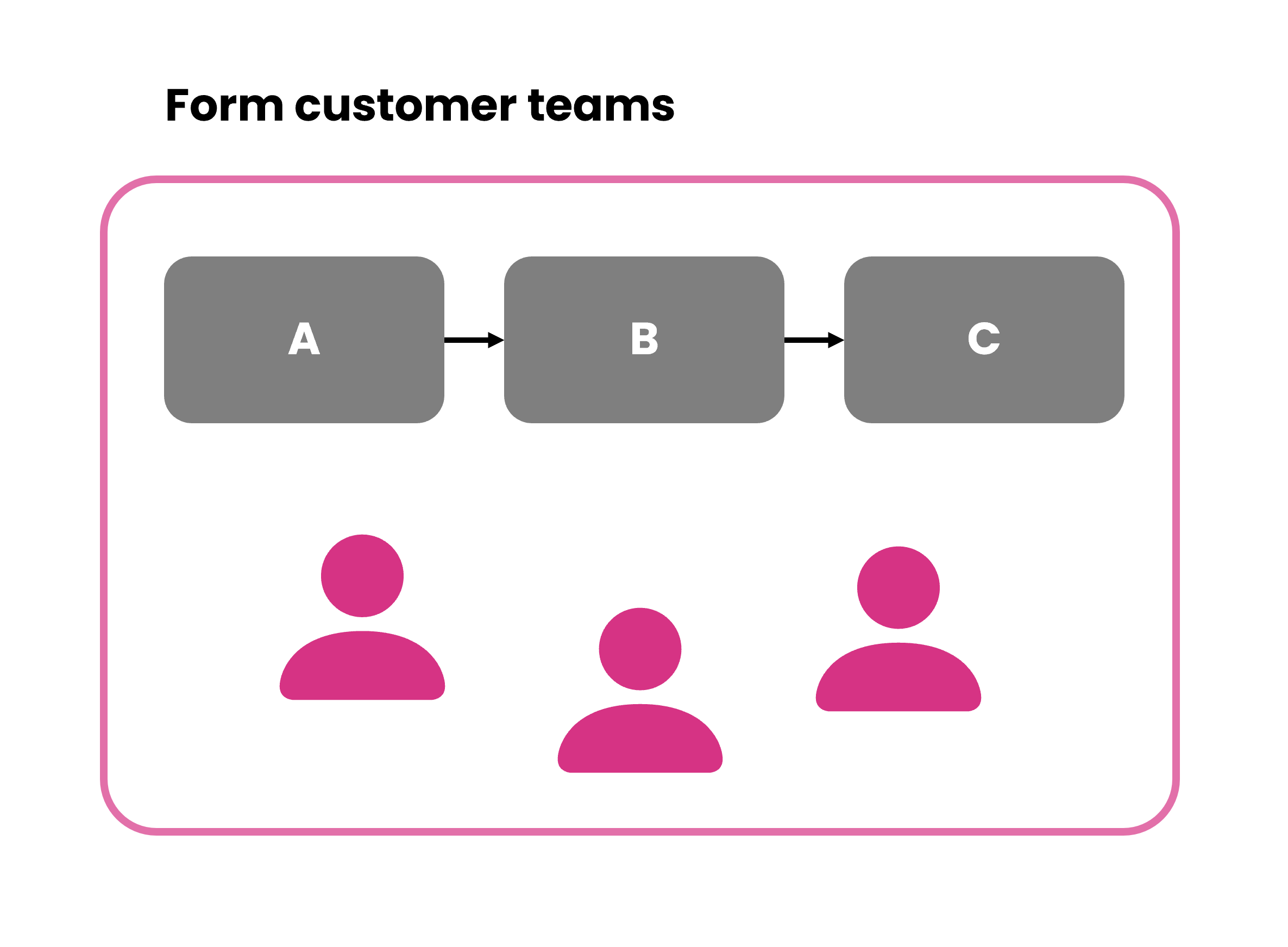
The heuristic is mentioned by Peppard and Rowland (1995) and Berg and Pottjewijd (1997).
Key Takeaways
- Organise around customers — Form teams around customer segments, regions or product lines instead of functional departments.
- Bring disciplines together — Combine the skills a case needs so that questions are resolved within the team.
- Define the case scope — Each team needs a clear set of cases it is responsible for end to end.
- Budget for coordination — Teamwork reduces handovers but requires time for alignment.
Performance considerations
■ This pattern ■ Baseline
In summary, customer teams offer a valuable solution for efficiently handling specific cases. By implementing this pattern, organizations can tap into the expertise of multiple workers while also promoting teamwork and enhancing overall quality.
The ratings show quality as the main beneficiary in the Devil’s Quadrangle: the team sees the whole case, combines different perspectives and offers the customer a consistent counterpart. Time and cost are neutral overall. Shorter communication lines and fewer handovers save time, but team coordination takes effort of its own and members may wait for each other. Flexibility is also neutral: resources dedicated to a team are less available for other work, but within the team members can cover for one another.
Example
Spotting the opportunity in event data
Framed along the FLAC rule types — fitness, location, attribute, constraint.
Fitness: processes in which cases for the same customer group pass through many departments with frequent back-and-forth. Location: handovers between departments on cases of a specific segment (e.g. key accounts, complex products) and clarification loops between functions. Attributes: departments and handovers per case, ping-pong between units, waiting time after handovers, repeat interactions per customer, segmentation by customer attributes. Constraints: low case volume per customer group, which would leave the team idle; highly standardised cases where a sequential flow is efficient; scarce specialists who cannot be dedicated to one team.
Sources & references
- Reijers, H., & Liman Mansar, S. (2005). Best practices in business process redesign: an overview and qualitative evaluation of successful redesign heuristics. Omega, 33(4) Summary on this site Publisher page DOI 10.1016/j.omega.2004.04.012
Enjoy these
Foundational free Patterns
Elevate physical constraints by applying new technology
Consider the division of a general activity into two or more alternative activities
Assign a responsible individual for handling each case type
Let workers perform as many steps as possible for single cases
Consider automating activities
Automate for environmental impact
Implement automation in a sustainable way
Buffer external information and subscribe to updates
Combine small activities into composite activities
Collect similar work items and work in batches
Constraint-based task assignment
Allocate tasks considering business process execution constraints
Connected to
Assign a responsible individual for handling each case type
Let workers perform as many steps as possible for single cases
Distribute tasks by interdepartmental interactions to enable or restrict involvement
Experience-based task assignment
Delegate task according to experience: execution frequency, case involvement, interactions
Allocate task based on collaborative experience: handover time, interactions, diversity