Green Compensation
Start implementing actions that can offset or counterbalance the environmental effects generated by business processes that cannot be changed.
category: Sustainability perspective: organizational/resource
Description
Some processes may be hard to redesign or restructure in regards to sustainability due to the nature of tasks they are performing or due to other internal restrictions.
The challenge is to find a proper solution for compensating the environmental impact without changing the process. In order to provide a trustworthy compensation, organizations can implement a certified compensation alternative to improve visibility at the customer’s site.
Because the process itself stays untouched, compensation is usually considered after reduction patterns such as Use eco-friendly resources, Green Variant or Automate for environmental impact have been ruled out. It addresses the impact you cannot avoid.
Solution
Whenever a business process that cannot be modified is initiated, a compensation process or activity is initiated, too. This process or activity compensates (parts of) the environmental impact caused by the original process.
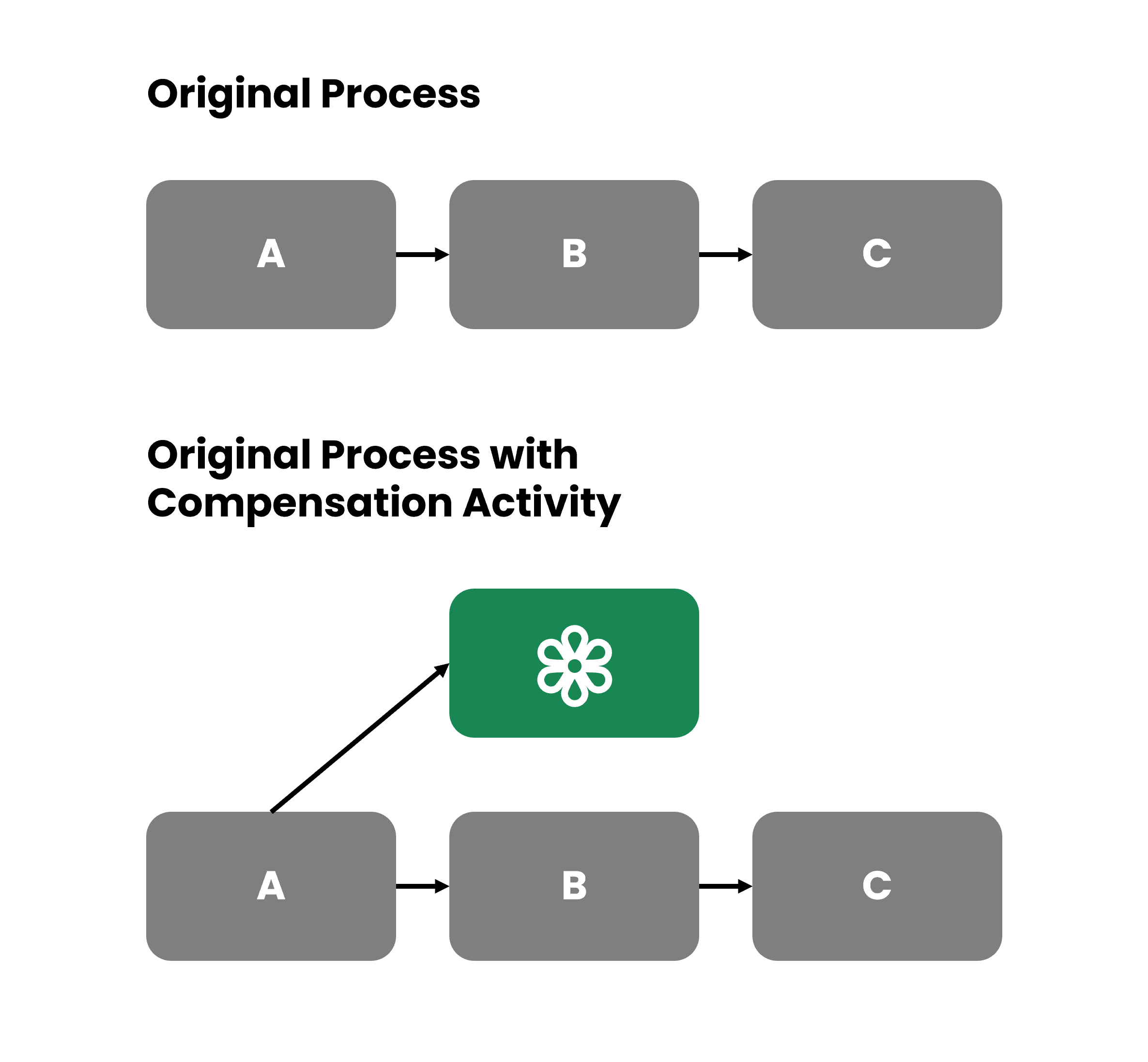 Green Compensation Illustration
Compensation can be triggered for every case or offered as a customer choice. In the latter form it overlaps with Green Variant, as the Lufthansa Green Fare case study shows: a bookable fare triggers a mix of sustainable aviation fuel and offsetting. Offsetting does not reduce the emissions of the process itself, so its credibility rests on the quality and certification of the compensation activity.
Variations
This pattern can be used in a custom way by using conditional compensations. For example, the compensation process or activity is only performed at every tenth initiation of the original process. This decision can be based on different aspects like waste that has been produced during process performance or the compensation value, for example.
Key Takeaways
- Unchangability — Certain processes may be difficult to reconfigure for sustainability due to their nature or internal constraints.
- Compensate — Initiate a compensatory process whenever an immutable business process begins, offsetting part or all of the original process’s environmental impact.
- Vary — The pattern can be customized with conditional compensations, such as initiating the compensatory process only after a set number of iterations of the original process, based on factors like waste produced or compensation value.
- Certify the offset — Use a certified compensation scheme so the offset is trustworthy and visible to customers.
- Reduce before you offset — Prefer patterns that change the process where possible; compensation covers only the residual impact.
Performance considerations
■ This pattern ■ Baseline
Although the original process cannot be modified, the implementation of the pattern is able to achieve an improvement of the environmental impact from a global point of view because negative effects are not reduced, but compensated by positive effects. These positive effects may be further improved through an environmental certification of the corresponding compensation activities.
The ratings reflect this. Sustainability improves markedly, because every execution of the original process is balanced by a compensation activity. Cost worsens, since each compensation, such as buying certified offsets or funding climate projects, adds an expense per case, unless customers pay for it, as with a bookable green fare. Time, quality and flexibility stay neutral, because the original process is not modified and the compensation runs alongside it. Keep in mind that the gain is an offset, not a reduction: the process emits as much as before.
Example
Production processes may require specific machines coming with a high upfront investment. These machines have certain well-defined process steps. The production waste originating from these machines, for example, may not be reduced without investing in new and expensive machines. So, although the production waste cannot be reduced, a donation for an environmental organization (e.g., for planting a tree or for buying rainforest) can be used to improve the environmental impact from a global perspective. Another example is the compensation of carbon emission occurred when burning fuel in auto mobiles. Oil companies provide a sustainability program that offers customers to compensate the amount of carbon dioxide for each refuel by investing in renewable energy.
On the site, the Lufthansa Green Fare case study shows the pattern in air travel.
Spotting the opportunity in event data
Framed along the FLAC rule types — fitness, location, attribute, constraint.
Fitness: Processes with a significant, measurable environmental impact that cannot be changed in the short term, e.g. production on fixed machinery, air or road transport. Location: The start or completion event of each case, where a compensation activity can be triggered, or every n-th case for the conditional variant. Attributes: Footprint drivers per case, such as fuel, distance, waste produced or energy used, which determine the compensation amount, plus customer choices or fare types if compensation is optional. Constraints: Apply only after checking that reduction patterns are not feasible; use certified schemes; avoid neutrality claims that overstate the effect, as environmental claims are increasingly regulated.
Sources & references
- Green Business Process Patterns - Part II
- Nowak, A., Leymann, F., Schleicher, D., Schumm, D., & Wagner, S. (2011, October 21). Green business process patterns. Proceedings of the 18th Conference on Pattern Languages of Programs. PLoP 11: Pattern Languages of Programs Conference 2011. Summary on this site Publisher page DOI 10.1145/2578903.2579144
Enjoy these
Foundational free Patterns
Elevate physical constraints by applying new technology
Consider the division of a general activity into two or more alternative activities
Assign a responsible individual for handling each case type
Let workers perform as many steps as possible for single cases
Consider automating activities
Automate for environmental impact
Implement automation in a sustainable way
Buffer external information and subscribe to updates
Combine small activities into composite activities
Collect similar work items and work in batches
Constraint-based task assignment
Allocate tasks considering business process execution constraints
Connected to
Consider the division of a general activity into two or more alternative activities
Offer a green alternative with the same outcome, utilizing different steps, resources, or partners, while retaining the previous existing process