Automate for environmental impact
Implement automation in a sustainable way
Nowak, A., Leymann, F., Schleicher, D., Schumm, D., & Wagner, S. (2011, October 21). Green business process patterns. Proceedings of the 18th Conference on Pattern Languages of Programs. PLoP 11: Pattern Languages of Programs Conference 2011. All sources
category: Sustainability
Description
Business processes are based on both human and IT supported activities that aim at achieving a certain strategic objective. These activities need to be organized in such a way that organizations are most profitable and ecological goals within a given environment can be met. Rationalizing some activities is one possibility to reach this objective.
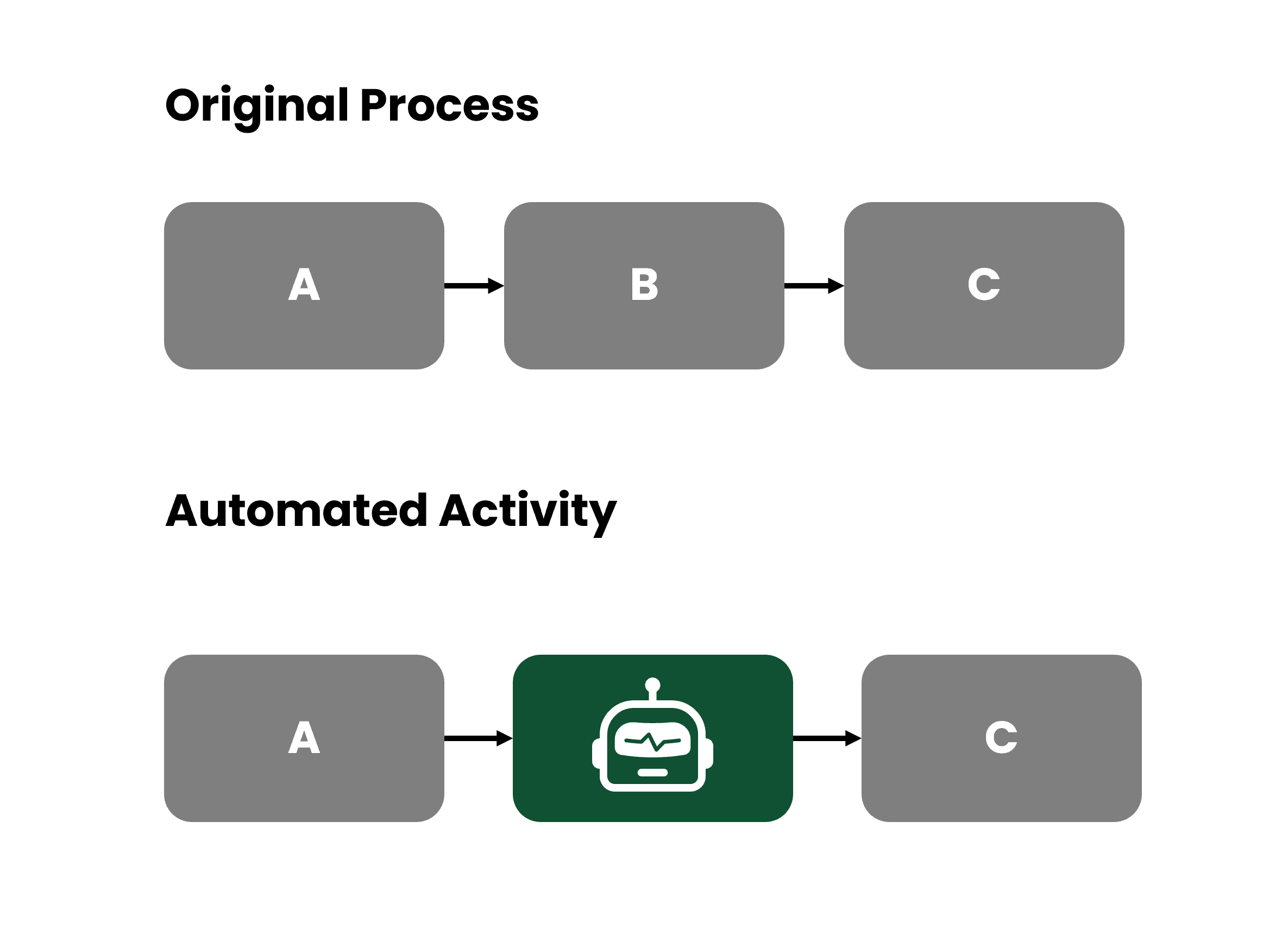 Green Automation
The pattern carries the classic redesign idea of task automation over to the ecological dimension. You look for activities whose manual or paper-based execution consumes material, transport or energy, and you replace them with an automated equivalent that has a smaller footprint.
Challenges
The identification of activities that can be automated can be a challenging task. The automated activity needs to perform the task in such a way that either the result remains the same or is even improved or the costs are getting much lower. In the latter case the trade-off between the environmental impact, the costs, and the expected quality needs to be addressed in detail. It must further ensure the global integration with other activities that are dependent on that activity.
Solution
Organizations (partially) streamline specific activities within a business process by automating them. Typical candidates are document-heavy steps such as printing, mailing and filing, manual data transfers that trigger physical shipments or travel, and repetitive checks. Automation is not free ecologically: the IT systems that execute the activity also consume energy and hardware, so the comparison has to cover both sides.
Variations
Single activities must not be totally automated. They can also be semi-automated or split into an automated and a manual part to better (i.e. more efficiently) support human process performance.
Relations to other patterns
This pattern is strongly related to Human Process Performance as it covers the contrary situation. Depending on the structure of the business process, both patterns can be used to ecologically optimize processes on an activity changing basis. The pattern is the sustainability-focused form of Automate activities, and it combines well with Shift Workload once the automated activity runs on IT infrastructure whose execution time can be shifted.
Key Takeaways
- Look for physical side effects — Prioritise activities whose manual execution causes paper, printing, transport or travel; automating them saves resources beyond labour time.
- Compare both footprints — Weigh the energy and hardware the automated solution needs against the footprint of the activity it replaces.
- Same or better result — The automated activity must deliver the same or a better outcome; if it is mainly cheaper, make the trade-off between environmental impact, cost and quality explicit.
- Partial automation counts — Semi-automating an activity, or splitting it into automated and manual parts, is a valid and often easier variant.
Performance considerations
■ This pattern ■ Baseline
The automatization of specific process activities provides the means for optimizations from both, a regular and an ecological perspective. Time, quality, and costs can be improved while energy consumption can be reduced, for example.
In the Devil’s Quadrangle the pattern improves time, cost and quality, as task automation generally does: automated activities run faster, cost less per execution and produce fewer errors. Flexibility is rated neutral. Automated steps handle standard cases well but can make exceptions harder to accommodate, which the semi-automated variants mitigate. On the sustainability dimension the pattern lowers the footprint by removing material consumption, logistics and travel tied to manual execution. The net benefit depends on the energy and hardware the automated solution requires, so measure both.
Example
Spotting the opportunity in event data
Framed along the FLAC rule types — fitness, location, attribute, constraint.
Fitness: Repetitive, high-volume processes with a low automation rate, e.g. invoicing, order confirmation or reporting. Location: Activities whose names or attributes point to physical execution, such as “Print invoice”, “Send letter” or “Scan document”, and manual handovers that trigger shipments. Attributes: Output channel per case (paper vs. electronic), resource type (human vs. system/batch user), case volume per activity and, where available, emission factors per channel joined to the log. Constraints: Don’t automate where regulation requires paper or a physical signature, where volume is too low to justify the IT footprint, or where customers must opt in to digital channels first.
Sources & references
- Nowak, A., Leymann, F., Schleicher, D., Schumm, D., & Wagner, S. (2011, October 21). Green business process patterns. Proceedings of the 18th Conference on Pattern Languages of Programs. PLoP 11: Pattern Languages of Programs Conference 2011. Summary on this site Publisher page DOI 10.1145/2578903.2579144
Enjoy these
Foundational free Patterns
Elevate physical constraints by applying new technology
Consider the division of a general activity into two or more alternative activities
Assign a responsible individual for handling each case type
Let workers perform as many steps as possible for single cases
Consider automating activities
Buffer external information and subscribe to updates
Combine small activities into composite activities
Collect similar work items and work in batches
Constraint-based task assignment
Allocate tasks considering business process execution constraints
Connected to
Elevate physical constraints by applying new technology
Consider automating activities
Consider whether it is eco-friendly to let humans work over machines