Green Variant
Offer a green alternative with the same outcome, utilizing different steps, resources, or partners, while retaining the previous existing process
category: Operation, Sustainability class: Routing Rules frameworkAspect: Operation view perspective: Control flow
Description
Within the optimization of business processes, organizations may not change their business processes to a greener one without making them, for instance, more expensive or violating internal policies (green trade-off). Doing so would probably lead to a decrease in market share. However, organizations may be able to offer an alternative business process variant that has less environmental impact than the original one and gives the customers the opportunity to decide between the conventional and the green variant.
Challenges
In this case it is important to assure the same functional outcome of the process. Consequently, processes must be analyzed and restructured with respect to this objective, however, obtaining a decreased environmental impact.
Solution
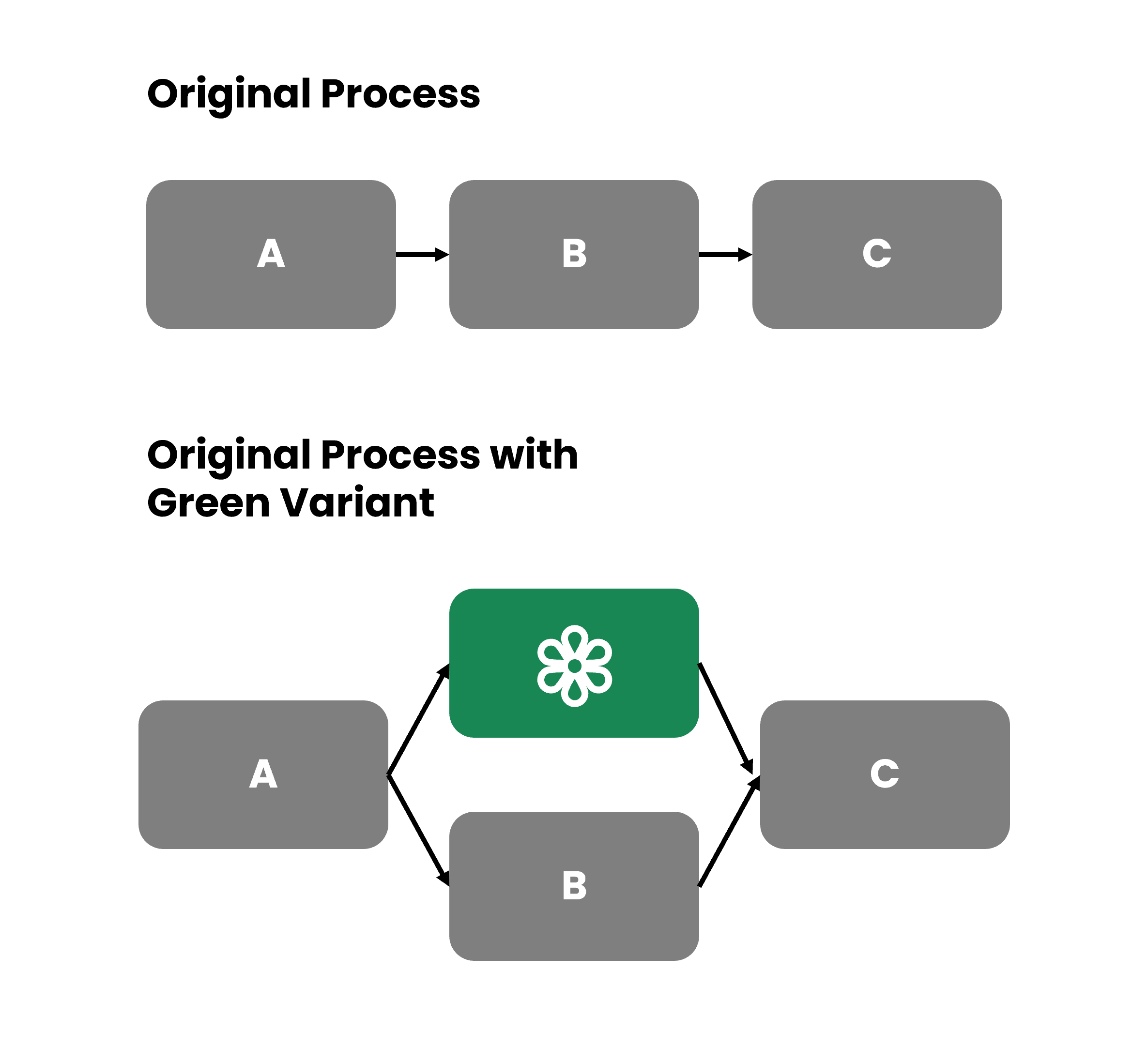
The organization provides an alternative green business process variant that achieves the same result as before. However, it may use different process steps, resources, or partners to perform the process. The previous existing business process remains.
Results
Based on certain criteria like the customers decision, different variants of the process with the same functional outcome can be provided. Depending on which of the variants is being executed, different key performance indicators and ecological parameters hold.
Variations
In the first place variations are achieved by conditioning the decision based on a certain criteria. Secondly, it would be possible to provide slightly different services or products. Depending on the business partners or customers choice, the service is performed differently (maybe with a different outcome) or products have another shape.
Structurally, the pattern adds an alternative path at a decision point, much like Apply triage or the explorative Process Differentiation, which also offers a priced variant next to the standard process. Here the distinguishing promise is a lower environmental impact.
Patterns 8 and 9 of the source are Green Outsourcing and Green Insourcing in this catalogue.
Key Takeaways
- Keep the original — Add a green variant next to the existing process instead of replacing it, which avoids the green trade-off.
- Same functional outcome — Both variants must deliver the same result; only steps, resources or partners differ.
- Let a criterion decide — Route cases into the green variant by customer choice or another criterion at a decision point.
- Track per variant — Measure KPIs and ecological parameters separately for each variant.
Performance considerations
Example
A trading company usually uses conventional plastic or styrofoam to wrap their goods. Using this pattern, the company can offer an alternative packaging method, using non-plastic and renewable materials, e.g. made out of corn, to pack the goods. In case of increasing costs they can provide this offer as a customer’s choice, i.e. customers decide whether they want conventional packaging or if they pay an extra charge for alternative packaging.
The Lufthansa Green Fare case study shows the same structure in air travel: the green fare can be booked alongside the existing fares and adds sustainable aviation fuel and offsetting, which combines this pattern with Green Compensation.
Spotting the opportunity in event data
Framed along the FLAC rule types — fitness, location, attribute, constraint.
Fitness: Processes with a single standard variant where a greener alternative exists but costs more or takes longer, e.g. packaging, shipping, travel or energy supply. Location: A decision point early in the process where the variant can be chosen, typically order entry or booking. Attributes: Materials, partners or transport modes per case, cost and lead time per alternative, and customer segments that already ask for sustainable options, e.g. in order notes or requests. Constraints: The green variant must reach the same functional outcome; check demand before adding it, because low uptake leaves the footprint almost unchanged while adding complexity.
Sources & references
- Green Business Process Patterns - Part II
- Nowak, A., Leymann, F., Schleicher, D., Schumm, D., & Wagner, S. (2011, October 21). Green business process patterns. Proceedings of the 18th Conference on Pattern Languages of Programs. PLoP 11: Pattern Languages of Programs Conference 2011. Summary on this site Publisher page DOI 10.1145/2578903.2579144
Enjoy these
Foundational free Patterns
Elevate physical constraints by applying new technology
Consider the division of a general activity into two or more alternative activities
Assign a responsible individual for handling each case type
Let workers perform as many steps as possible for single cases
Consider automating activities
Automate for environmental impact
Implement automation in a sustainable way
Buffer external information and subscribe to updates
Combine small activities into composite activities
Collect similar work items and work in batches
Constraint-based task assignment
Allocate tasks considering business process execution constraints
Connected to
Start implementing actions that can offset or counterbalance the environmental effects generated by business processes that cannot be changed.