Split responsibilities
Avoid shared responsibilities for tasks by people from different functional units
Reijers, H., & Liman Mansar, S. (2005). Best practices in business process redesign: an overview and qualitative evaluation of successful redesign heuristics. Omega, 33(4) All sources
category: Organization class: Allocation Rules frameworkAspect: Organizational Structure perspective: organizational/resource
Description
The idea behind this redesign pattern is that tasks for which different departments share responsibility are more likely to be a source of neglect and conflict.
When responsibility for a task is shared across functional units, it is often unclear who has to act, who decides in case of disagreement and who answers for the result. Work items may remain untouched because each unit assumes the other will handle them, or be handled twice with conflicting outcomes. The pattern therefore recommends assigning each task to one functional unit, so that responsibilities are split rather than shared.
Splitting responsibilities does not mean only one person may work on a task; it means one unit is accountable and allocates the work within its own pool. Typical symptoms are work queues shared by two departments, tasks that require joint action by two functions, and items that move back and forth because neither side feels in charge. The pattern complements Minimize numerical involvement, which reduces the number of parties per case, and Appoint case managers, which assigns accountability for a whole case rather than for individual tasks.
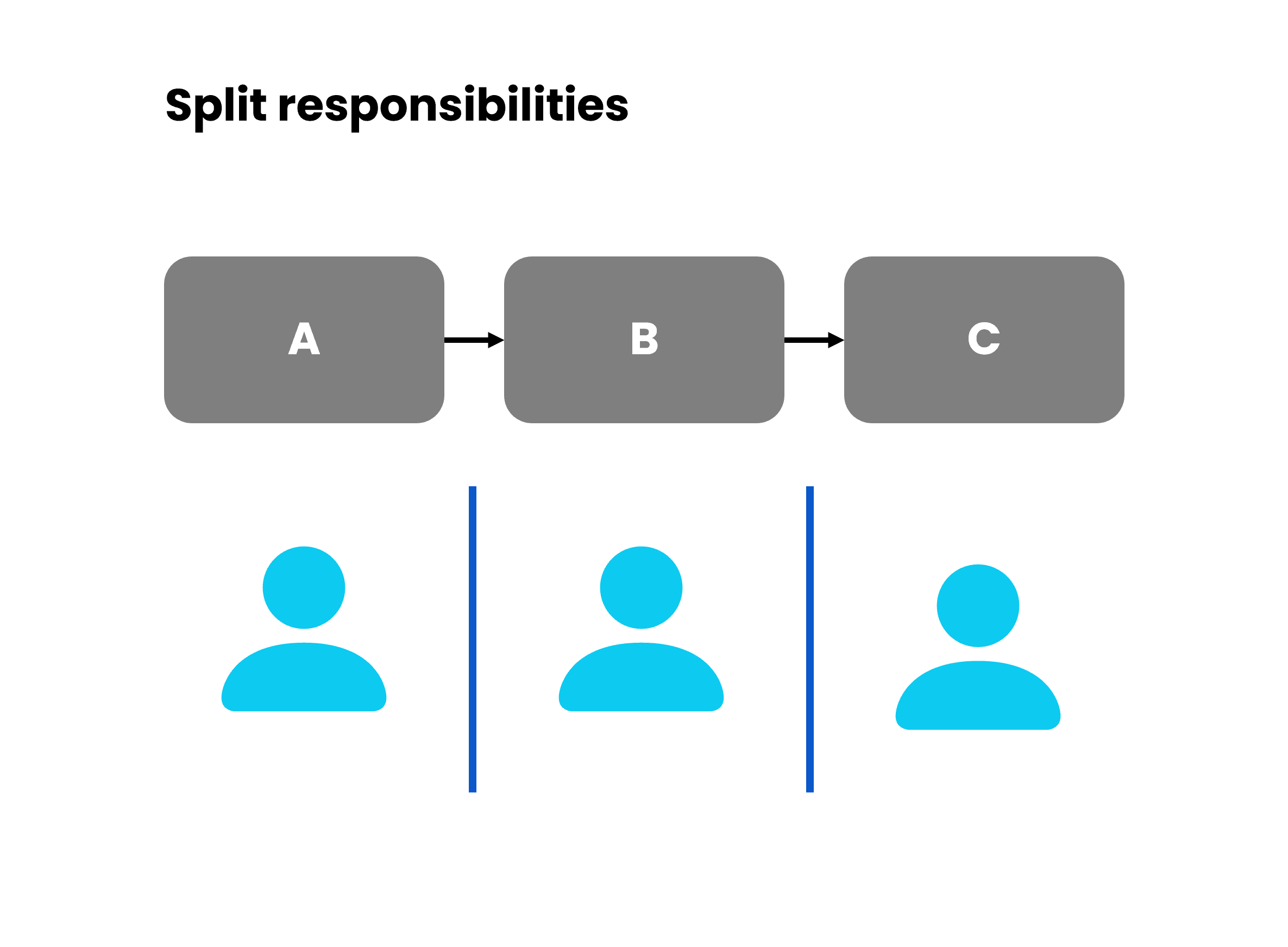 Split task responsibilities
Key Takeaways
- One task, one accountable unit — Assign every task to a single functional unit that owns its execution and result.
- Look for ping-pong — Work items bouncing between departments are a strong sign of unclear responsibility.
- Mind the smaller pool — Fewer eligible resources per task can lengthen queues, so capacity must match.
- Clarify decision rights — Where input from several functions is needed, define who provides input and who decides.
Performance considerations
■ This pattern ■ Baseline
Reducing the overlap in responsibilities should lead to a better quality of task execution. A higher responsiveness to available work items may be developed also, so that clients are served quicker. On the other hand, reducing the effective number of resources that is available for a work item may have a negative effect on its throughput time, as more queuing may occur.
In line with this, the pattern is rated as improving quality, neutral on time and cost, and worsening flexibility in the Devil’s Quadrangle. The quality gain comes from clear accountability: fewer neglected or duplicated work items and fewer conflicts. Time is neutral overall, because the faster response of a clearly responsible unit is offset by longer queues when fewer resources are eligible. Flexibility worsens because work can no longer be shifted to the other unit when one is overloaded.
Example
Spotting the opportunity in event data
Framed along the FLAC rule types — fitness, location, attribute, constraint.
Fitness: processes in which the same activity is executed by resources from several departments. Location: activities performed by more than one organisational unit, and ping-pong handovers between two units on the same case. Attributes: distinct departments per activity, share of work items that are reassigned, forwarded or returned, idle time before pick-up, duplicate executions of the same activity within a case. Constraints: tasks that genuinely require two perspectives, such as four-eyes approvals; units too small to handle the volume alone.
Sources & references
- Reijers, H., & Liman Mansar, S. (2005). Best practices in business process redesign: an overview and qualitative evaluation of successful redesign heuristics. Omega, 33(4) Summary on this site Publisher page DOI 10.1016/j.omega.2004.04.012
Enjoy these
Foundational free Patterns
Elevate physical constraints by applying new technology
Consider the division of a general activity into two or more alternative activities
Assign a responsible individual for handling each case type
Let workers perform as many steps as possible for single cases
Consider automating activities
Automate for environmental impact
Implement automation in a sustainable way
Buffer external information and subscribe to updates
Combine small activities into composite activities
Collect similar work items and work in batches
Constraint-based task assignment
Allocate tasks considering business process execution constraints