Assisted business process redesign
A semi-automated approach for process improvement based based on process data, best practices and simulation
Fehrer, T., Fischer, D. A., Leemans, S. J. J., Röglinger, M., & Wynn, M. T. (2022). An assisted approach to business process redesign. Decision Support Systems
Research paper
A semi-automated approach for process improvement based based on process data, best practices and simulation
In practice, BPM experts often work together with information carriers to find ideas for process improvements. In this knowledge-intensive process, methodological and domain knowledge must be creatively linked. However, the combination of knowledge and creativity is often not given in workshops. This assisted approach therefore provides recommendations for improvements that are iteratively and partially automated implemented into the process. Simulations help to assess the impact of the process improvements.
Citation: Fehrer, T., Fischer, D. A., Leemans, S. J. J., Röglinger, M., & Wynn, M. T. (2022). An assisted approach to business process redesign. Decision Support Systems Read: http://dx.doi.org/10.1016/j.dss.2022.113749
My PhD note: P4 – Assisted Business Process Redesign (aBPR)
Author(s): Tobias Fehrer (process-pattern.app)
Abstract
For many organizations, the continuous optimization of their business processes has become a critical success factor. Several related methods exist that enable the step-by-step redesign of business processes. However, these methods are mainly performed manually and require both creativity and business process expertise, which is often hard to combine in practice. To enhance the quality and effectiveness of business process redesign, this paper presents a conceptualization of assisted business process redesign (aBPR). The aBPR concept guides users in improving business processes based on redesign patterns. Depending on the data at hand, the aBPR concept classifies four types of recommendations that differ in their level of automation. Further, this paper proposes a reference architecture that provides operational support for implementing aBPR tools. The ra has been instantiated as a prototype and evaluated regarding its applicability and usefulness in artificial and naturalistic settings by performing an extensive real-world case study at KUKA and interviewing experts from research and practice.
Content
Best practices document successful solutions to known problems. In process improvement, redesign patterns enjoy great popularity as best practices because they expand the solution space of redesign options. They describe ideas such as parallelizing sequential tasks, deleting unnecessary tasks, or terminating processes as early as possible to save time, reduce costs, increase quality, or enable flexibility. The figure below demonstrates, for example, the application of parallelization, for which there must be no dependencies between the data.
New process designs in four steps
The basis for the application of redesign patterns is a process model and process improvement objectives. The application of the patterns then follows a repeatable scheme of four successive work steps, at the end of which new process models are created:
- Select redesign patterns that, based on their description and functionality, are generally suitable for the process at hand.
- Identify suitable places in the process model where the pattern can be applied.
- Create (multiple) alternative process models through modeling.
- Evaluate the process redesign option by assessing the impact on the process improvement goals and balancing the effort required for subsequent implementation.
Techniques based on process data, algorithms, manual modeling or AI models can be utilized to (partially) automate the four work steps. This allows the generation of increasingly specific recommendations in four levels of automation (AL1-AL4), which can support users in process improvement.
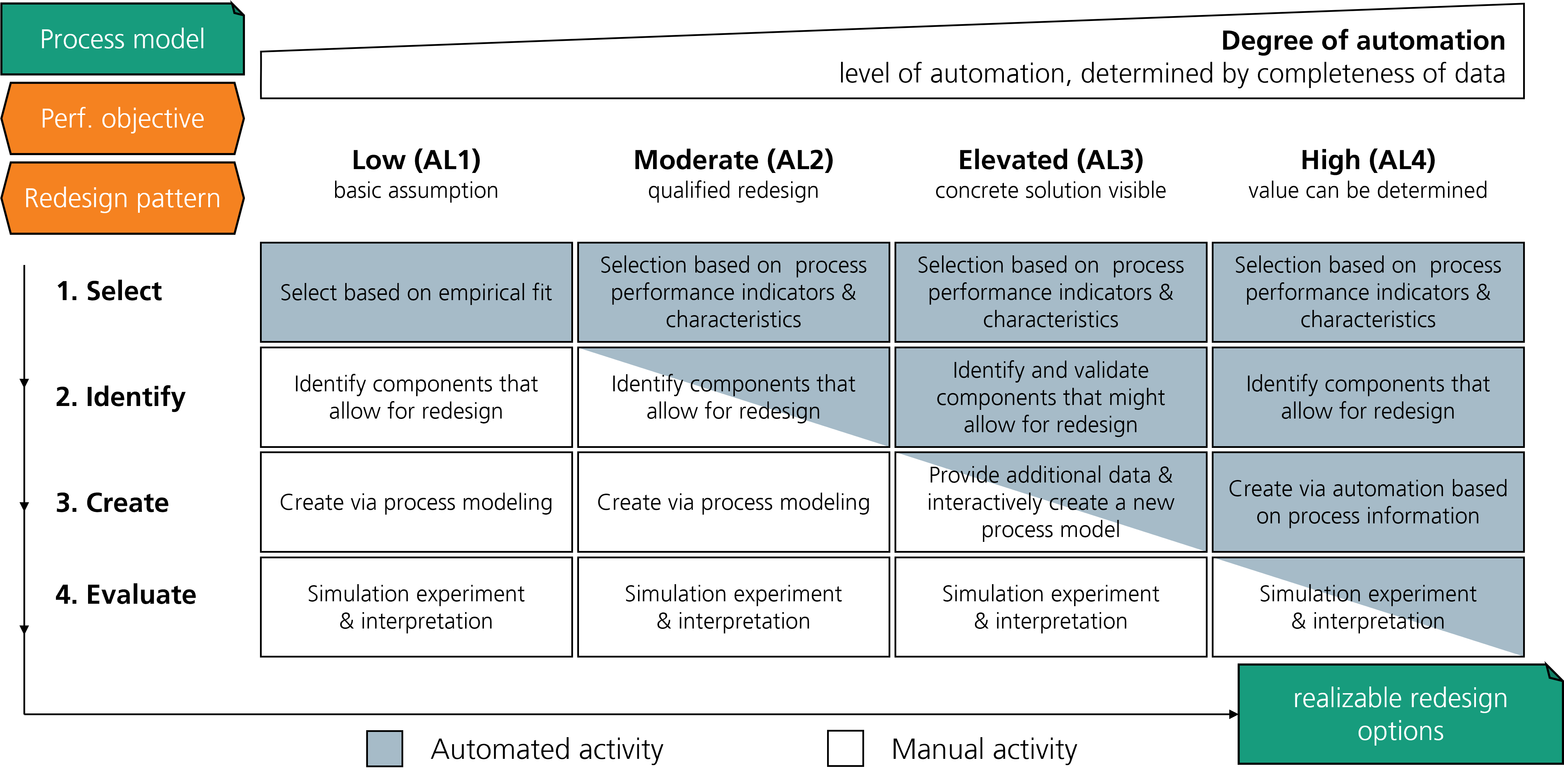 Conceptualization of assisted process model improvement
Prototype and evaluation
In a design-oriented research approach, a prototype was developed to engage users with process domain knowledge. The prototype is a modeling environment for BPMN diagrams that suggests recommendations for redesign options and simulates what-if scenarios. The goal is to combine existing approaches and techniques into a systematic approach that already delivers value to practitioners today, while being continuously extensible. For this purpose, the prototype is based on a novel reference architecture.
During the evaluation of the approach and the prototype, close cooperation with practitioners was particularly valuable for the result: Eight interviews with experts from the academic environment and two preparatory case studies with five practitioners laid the foundation for an extensive case study with eight participants from the company KUKA. Under real-world conditions, three redesign options with a total of >35% time savings in a logistics process were identified in a workshop held there. The users considered the prototype useful.
Demo Video of aBPR
GitHub - dtdi/assisted-bpr-modeler: A modeler application for assisted Business Process Redesign of BPMN process diagrams.
A modeler application for assisted Business Process Redesign of BPMN process diagrams. - GitHub - dtdi/assisted-bpr-modeler: A modeler application for assisted Business Process Redesign of BPMN pr…